
Mobile driving simulators have become incredibly advanced over the past few years. Gone are the days when racing games were only about speed; today’s players want realistic physics, smooth handling, and immersive worlds that replicate real-life driving. Two of the biggest names in this category are CPM by Olzhass and PetrolHead by Lethe Studios.
Both games promise a lifelike experience, but they take different routes to deliver it. Car Parking Multiplayer vs PetrolHead focuses on open-world exploration and multiplayer freedom, while PetrolHead refines the driving experience through precision, smooth physics, and elegant graphics. So, which one actually feels more realistic behind the wheel? Let’s break down how these two powerhouse simulators compare in every major category, from car physics and tuning systems to control response and overall driving feel.
Car Parking Multiplayer
Car Parking Multiplayer is one of the most popular open-world driving simulators on Android and iOS. It’s not just a parking game; it’s a complete car life simulation. Players can drive anywhere, interact with others online, trade cars, and even roleplay as police officers or taxi drivers. The maps are massive, filled with real traffic, gas stations, and buildings you can enter.
The standout feature is its multiplayer mode, which brings real people into your world, making every drive unpredictable and exciting. What sets this game apart, though, is its physics system. Cars react to bumps, terrain changes, and collisions in a surprisingly realistic way. Combine that with manual transmission options, clutch control, and dynamic weight shifting, and you’ve got one of the most detailed driving systems in mobile gaming.
PetrolHead
PetrolHead takes a more polished and cinematic approach to realism. Developed by Lethe Studios, it focuses heavily on precision driving, clean city environments, and highly optimized car handling. The moment you hit the road, you notice how refined the steering feels, no unnecessary jerks or exaggerated turns. The braking and acceleration are carefully balanced, creating a natural driving rhythm that mimics real-world vehicle behavior.
While PetrolHead doesn’t offer the vast multiplayer sandbox of CPM, it wins in terms of stability and fluidity. The frame rate is incredibly consistent, even on mid-range devices, and the overall look of the world feels smoother. The developers clearly prioritized control realism over open-world chaos, and it pays off beautifully.
Visuals and Environment Design
When comparing graphics, it’s like choosing between scale and polish. Car Parking Multiplayer vs PetrolHead offers massive maps with live players, traffic, pedestrians, and interactive zones. Its environment feels alive; there’s always movement, sounds, and action happening around you. However, due to its scale, textures can sometimes appear slightly rough or pixelated on lower-end devices.
PetrolHead, on the other hand, opts for smaller but more detailed worlds. Every building, road, and reflection feels sharp and refined. Lighting and shadows are more natural, giving the world a premium look. However, its environments are less dynamic, have fewer AI vehicles, no interactive multiplayer, and limited map variety. So, if you value immersion through activity, CPM wins. But if you prefer cleaner visuals and smoother rendering, PetrolHead takes the crown.
Driving Physics
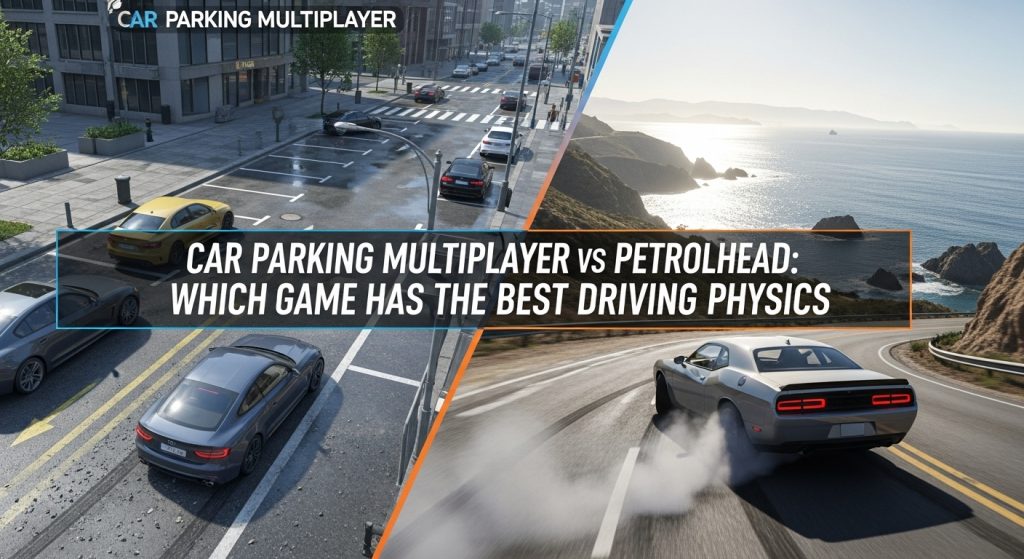
Here’s where things get interesting. Driving physics are the soul of both games, and they approach realism differently. In CPM, cars feel heavy, grounded, and responsive to terrain. You can sense weight distribution when turning sharply or braking hard. Driving through sand, grass, or asphalt actually feels different, something many simulators fail to achieve. Manual transmission, clutch control, and realistic engine sound further add to the immersion.
PetrolHead goes for precision. Its physics system focuses on control accuracy and vehicle balance. Every steering adjustment feels smooth, and the cars glide naturally without oversteer or stiff handling. The sensation of momentum is more refined, making it ideal for players who enjoy technical driving and precision cornering. If you want a realistic driving feel with variety and challenge, CPM wins. If you want technical accuracy and consistent balance, PetrolHead takes the lead.
Car Customization and Tuning
Customization is another area where these games differ drastically. Car Parking Multiplayer offers deep tuning options, players can change suspension height, engine power, turbo boost, wheel size, and even create aesthetic designs with wraps and decals. These changes affect how the car drives; for example, lowering the suspension improves grip but reduces comfort on bumpy roads. The garage system is a playground for creative players who love modifying performance and style.
PetrolHead, by contrast, keeps customization minimal but meaningful. You can tune your engine, upgrade performance parts, and adjust visual elements, but everything feels balanced and realistic. It’s not about wild modifications, it’s about fine-tuning a car for smooth driving. Car Parking Multiplayer vs PetrolHead wins for creative freedom and dynamic tuning. PetrolHead wins for simplicity and realistic adjustment.
Multiplayer Experience and Community
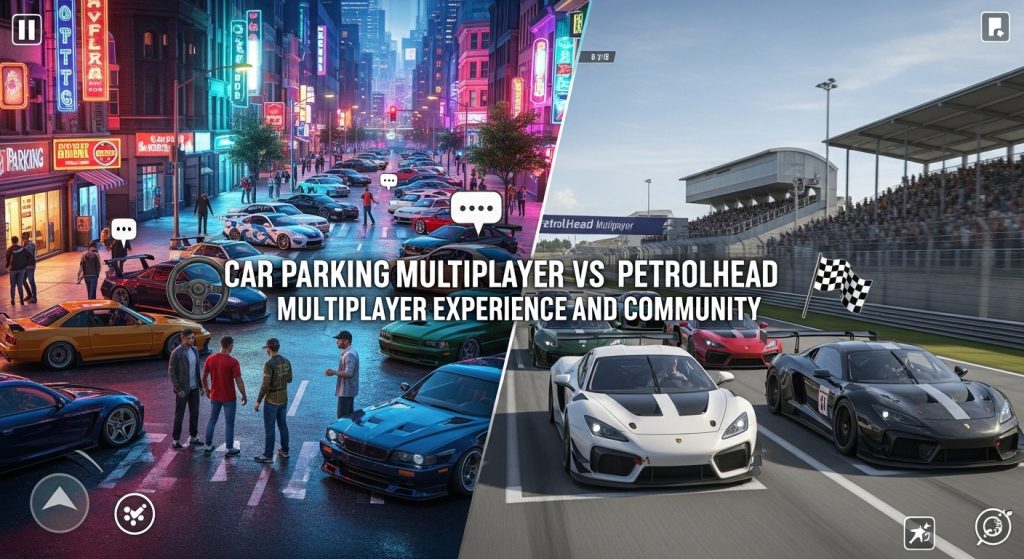
Multiplayer realism adds a whole new dimension to CPM. The game’s open-world online mode lets players host or join servers, interact through voice chat, trade vehicles, and even roleplay. Every session feels different because you’re dealing with real people. Traffic jams, car meets, and spontaneous races create an unpredictable yet authentic driving world.
PetrolHead is more of a solo journey. It focuses on single-player missions, traffic driving, and personal progress. While some versions include limited online functionality, it doesn’t match the large-scale interaction of Car Parking Multiplayer vs PetrolHead. If you believe realism comes from real-world unpredictability and player behavior, CPM is the clear winner.
Sound, Controls, and Camera Feel
Sound and control systems define how immersive a simulator feels. In CPM, engine sounds vary by car, and tire squeals, gear shifts, and ambient noises enhance the experience. However, some users report slight control sensitivity issues when switching from mobile to emulator.
PetrolHead shines here, its sound design is crisp, engine revs are perfectly tuned, and the steering feels consistent across devices. The camera transitions are smoother, creating a cinematic experience during replays and cornering. So, for sensory realism, PetrolHead wins. For raw intensity and variety, CPM leads.
Performance and Optimization
Because of its large open world and live multiplayer, Car Parking Multiplayer vs PetrolHead demands more from your device. On older phones, it may lag slightly in busy cities or large online rooms. The PC version, through emulators like BlueStacks or LDPlayer, performs better, offering smoother gameplay.
PetrolHead is lighter and better optimized for all kinds of devices. It maintains high frame rates without sacrificing visual quality. The app size is smaller too, making it accessible even for users with limited storage. In short, CPM delivers scale, while PetrolHead delivers stability.
Realism Beyond Physics
Realism isn’t only about technical physics; it’s also about the feel of driving. Car Parking Multiplayer vs PetrolHead creates a sense of life through its multiplayer chaos, open-world traffic, and daily driving routines. It feels like living in a virtual car world.
PetrolHead focuses on solitude, precision, and smoothness. Every mission feels deliberate, and the clean interface keeps you focused purely on driving. It’s less noisy, more elegant, and more meditative. For immersion and variety, CPM takes the win. For peace, polish, and control, PetrolHead edges ahead.
Conclusion Car Parking Multiplayer vs PetrolHead
Both games excel, but in different ways. CPM feels like real driving, unpredictable, dynamic, and full of life. The cars react naturally to terrain and player behavior, creating a full simulation experience. PetrolHead, however, offers smoother and more consistent control; it feels engineered for precision rather than realism’s chaos.
If you want a game that feels alive and lets you experience all aspects of car life, multiplayer, traffic, tuning, and exploration, choose Car Parking Multiplayer vs PetrolHead. If you’re after pure control, buttery-smooth handling, and elegant visuals, PetrolHead might suit you better. Either way, both push mobile driving realism to new heights, and whichever one you pick, you’re in for a fantastic ride.